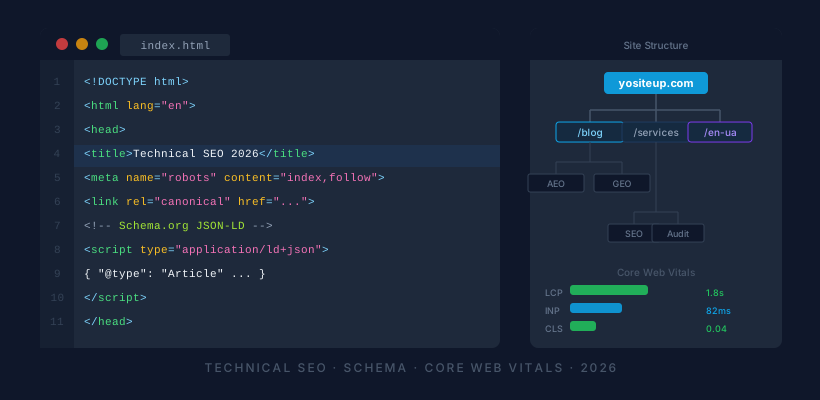
Technical SEO remains the foundation of any effective search strategy. Without a technically sound site, even the best content and AEO practices won't deliver full results. Here are the key technical and content optimization considerations for 2026.
Private Blog Networks: Risks and Alternatives in 2026
PBNs carry significant risks in 2026, but the risk-benefit analysis has changed. A clear-eyed assessment — in the article about private blog networks for SEO in 2026.
Technical Site Support and SEO
How ongoing technical maintenance affects search performance — practical guide in technical support for the site and SEO.
Unique Content in the Age of AI
What counts as unique content in 2026 and how Google's systems detect and evaluate it — in unique content for SEO in 2026.
Google Ads Data Retention: June 2026 Changes
The data retention policy changes affecting campaign analysis and reporting — in Google Ads data retention policy June 2026.
SEO Premium Case Study
A detailed case study showing results from premium SEO work on a competitive market — in SEO premium package case study.
What unique content means in the AI era
The standard definition of "unique content" — text that isn't copied verbatim from other sources — is no longer sufficient for SEO success in 2026. Google's systems can now identify content that is original in text but derivative in perspective, adding nothing to what already exists. Genuinely unique content in 2026 means one or more of: original research or data not available elsewhere, a novel perspective or analysis backed by expertise, a synthesis of information that's more comprehensive or accurate than existing sources, or practical guidance based on first-hand experience. Sites that produce content unique in this deeper sense consistently outperform those producing text that's technically unique but intellectually derivative.
Private blog networks in the current environment
PBNs carry substantially higher risk in 2026 than they did in previous years. Google's link spam detection has improved dramatically, and the potential downside of a manual penalty has grown as sites become more dependent on organic traffic for revenue. For most legitimate businesses, the risk-reward calculation for PBN use is clearly unfavorable. The resources required to build and maintain an effective PBN that avoids detection could typically be better invested in creating linkable assets — original research, tools, or comprehensive guides that earn natural links from relevant sources.
Core Web Vitals in 2026: updated priorities
Google's Core Web Vitals metrics have evolved in 2026, with INP (Interaction to Next Paint) now fully replacing FID (First Input Delay) as the responsiveness metric. Sites that haven't re-audited their performance metrics since 2023 may find their INP scores are worse than their old FID scores, even without any changes to the site — because INP measures a broader set of interactions. For Ukrainian market sites, the most common INP issues come from excessive JavaScript execution, large third-party scripts (analytics, chat widgets, social embeds), and event handlers that block the main thread. Fixing these typically requires developer involvement but often produces significant performance improvements.